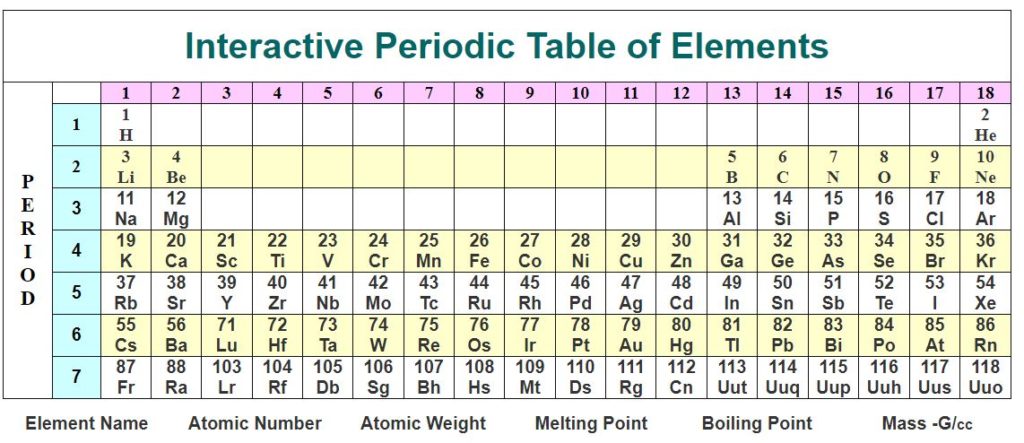
The Periodic Table

Dimitri Mendeleev's Periodic Table of Elements and Atomic Numbers


The Periodic Table based on the *IOUPAC 1985 standard                                  Periodic Table Elements Map

Click on an Element in the Periodic Table - More Information will be displayed under the table

Element Name Atomic Number Atomic Weight Melting Point Boiling Point  Mass -G/cc

For convenience due the limitations of screen width the Periodic Table above does not include the Lanthanides (group six) or Actinides (group seven) which reside between group 2 and group 3
of the periodic table shown above. They are however listed separately in the table below.


6 57
La
58
Ce
59
Pr
60
Nd
61
Pm
62
Sm
63
Eu
64
Gd
65
Tb
66
Dy
67
Ho
68
Er
69
Tm
70
Yb
7 89
Ac
90
Th
91
Pa
92
U
93
Np
94
Pu
95
Am
96
Cm
97
Bk
98
Cf
99
Es
100
Fm
101
Md
102
No

*IOUPAC
The Periodic Table is based on the IOUPAC 1985 Standard. IOUPAC stands for the International Union of Pure Applied Chemistry.

Groups
Properties within each individual group are similar, but nevertheless vary within a group. Generally chemical activity decreases as the period increases a non-metal group and increases as the period increases within a metal group. The first element in a group is always an active metal, the last is always an inactive non-metal.

Periods
The period of an element signifies the highest energy level an electron in that element occupies in an unexcited state. Generally, within a given period, the chemical activity of metals increases with the group number , while the chemical activity of non-metals within a given period decreases with the group number.

Classification of Elements on the Periodic Table
The elements displayed on the Periodic Table are classified as:

  • Metalloids

  • Alkali metals

  • Alkaline Earth Metals

  • Transition Metals

  • Other Metals

  • Non-metals

  • Halogens

  • Noble Gases

  • Rare Earth Elements

Elements classified as Metalloids
The 7 elements classified as "Metalloids" are located in Groups 13, 14, 15, 16 and 17 elements of the Periodic Table. Elements classified as Metalloids have properties of both metals and non-metals. Some are semi-conductors and can carry an electrical charge making them useful in calculators and computers.
The Metalloids on the Periodic Table are:

  • Boron

  • Silicon

  • Germanium

  • Arsenic

  • Antimony

  • Tellurium

  • Polonium

Elements classified as Alkali Metals
The 6 elements classified as "Alkali Metals" are located in Group 1 elements of the Periodic Table. Elements classified as Alkali Metals are very reactive metals that do not occur freely in nature. Alkali metals are soft, malleable, ductile, and are good conductors of heat and electricity. The Alkali Metals are:

  • Lithium

  • Sodium

  • Potassium

  • Rubidium

  • Cesium

  • Francium

Elements classified as Alkaline Earth Metals
The 6 elements classified as "Alkaline Earth Metals" are located in Group 2 elements of the Periodic Table. Elements classified as Alkaline Earth Metals are all found in the Earth’s crust, but not in the elemental form as they are so reactive. Instead, they are widely distributed in rock structures. The Alkaline Earth Metals on the Periodic Table are:

  • Beryllium

  • Magnesium

  • Calcium

  • Strontium

  • Barium

  • Radium

Elements classified as Transition Metals
The elements classified as "Transition Metals" are located in Groups 3 - 12 of the Periodic Table. Elements classified as Transition Metals are ductile, malleable, and conduct electricity and heat. The Transition Metals on the Periodic Table are:
 

  • Scandium

  • Titanium

  • Vanadium

  • Chromium

  • Manganese

  • Iron

  • Cobalt

  • Nickel

  • Copper

  • Zinc

  • Yttrium

  • Zirconium

  • Platinum

  • Gold

  • Mercury

  • Rutherfordium

  • Dubnium

  • Seaborgium

  • Bohrium

  • Hassium

  • Meitnerium

  • Ununbium

  • Niobium

  • Iridium

  • Darmstadtium

  • Molybdenum

  • Technetium

  • Ruthenium

  • Rhodium

  • Palladium

  • Silver

  • Cadmium

  • Hafnium

  • Tantalum

  • Tungsten

  • Rhenium

  • Osmium


Elements classified as Other Metals
The 7 elements classified as "other metals" are located in groups 13, 14, and 15 of the Periodic Table. All of these elements are solid, have a relatively high density and are opaque.
The "Other Metals" on the Periodic Table are:

  • Aluminum

  • Gallium

  • Indium

  • Tin

  • Thallium

  • Lead

  • Bismuth

Elements classified as Non-metals
The 7 elements classified as "Non-metals" are located in Groups 14,15 and 16 of the Periodic Table. Non-metals are not easily able to conduct electricity or heat and do not reflect light . Non-metallic elements are very brittle, and cannot be rolled into wires or pounded into sheets. Non-metallic elements exist, at room temperature, in two of the three states of matter : gases (such as oxygen) and solids (such as carbon).
The Non-Metal elements on the Periodic Table are:

  • Hydrogen

  • Carbon

  • Nitrogen

  • Oxygen

  • Phosphorus

  • Sulfur

  • Selenium

Elements classified as Halogens
The 5 elements classified as "halogens" are located in Group 7 of the Periodic Table.
The term "halogen" means "salt-former" and compounds containing halogens are called "salts". The halogens exist, at room temperature, in all three states of matter - Gases such as Fluorine & Chlorine, Solids such as Iodine and Astatine and Liquid as in Bromine. The Halogen elements on the Periodic Table are:

  • Fluorine

  • Chlorine

  • Bromine

  • Iodine

  • Astatine

Elements classified as Noble Gases
The 6 elements classified as "Noble Gases" are located in Group 18 of the Periodic Table. The elements forming the Six Noble Gases on the Periodic Table are:

  • Helium

  • Neon

  • Argon

  • Krypton

  • Xenon

  • Radon

Elements classified as Rare Earth Elements
The elements classified as "Rare Earth Elements" are located in Group 3 of the Periodic Table and in the 6th and 7th periods. The Rare Earth Elements are of the Lanthanide and Actinide series. Most of the elements in the Actinide series are synthetic or man-made. The Lanthanide and Actinide series of Rare Earth Elements on the Periodic Table are:
 

Lanthanide Elements

Actinide Elements

Lanthanum
Cerium
Praseodymium
Neodymium
Promethium
Samarium
Europium
Gadolinium
Terbium
Dysprosium
Holmium
Erbium
Thulium
Ytterbium
Lutetium
Actinium
Thorium
Protactinium
Uranium
Neptunium
Plutonium
Americium
Curium
Berkelium
Californium
Einsteinium
Fermium
Mendelevium
Nobelium
Lawrencium


Dimitri Mendeleev and the History of the Periodic Table
Dimitri Mendeleev was born on February 7th 1834 in Tobolsk, a Town in Siberia. In 1869 at the age of 35 the famous Russian Scientist perceived a totally new classification Method "the periodic table", he included all the 65 elements known in his time by their atomic weights and chemical valency. Mendeleev then went even further, using the remaining gaps and spaces in his periodic table, he correctly concluded that a further group of yet unknown elements must exist in order to fill in the gaps in his Periodic Table, this group we now know as the lanthanides, and is Group six of our modern Standardised Periodic Table.

The Modern Periodic Table
Fifty years after Dimitri Mendeleev created the Periodic cable, the British scientist Henry Moseley discovered that the number of protons in the nucleus of a particular type of atom was always the same. When atoms are arranged via their atomic number, the few remaining problems with Mendeleev's original periodic table disappeared. Due to Moseley's work, the modern periodic table is based on the atomic numbers of the elements rather than atomic mass.

Dimitri Mendeleev's work on the Periodic Table recognised
Dimitri Mendeleev has clearly left his mark on modern science, indeed all modern Scientists are familiar with Standardised version of his Periodic table. Mendeleyev's homeland, Russia, has recognised the significance of his work by naming the "Mendeleyev University of Chemical Technology" in Moscow in his honour.

IUPAC and the modern standardised Periodic Table
The standardised periodic table in use today was agreed by the International Union of Pure Applied Chemistry, IUPAC, in 1985 and now recognises more periods and elements than Dimitri  Mendeleev knew in his day but still all fitting into his concept of  the "Periodic Table".
 

Elements Map !
For additional information about the elements featured on the Periodic Table please refer to our comprehensive Elements Map!

Online Science Quiz!!
Can you meet the challenge of our Online Science Quiz? It's fast, informative, fun and totally interactive! How long will it take for you to reach the Online Science Quiz winner's Hall of Fame?

The Periodic Table

The Periodic Table - the most important chemistry reference there is, and
the cornerstone of science since 1869


Chemistry - Substances - Compounds - Chemistry - Parts - Building blocks - Components - Factors - Modules - Constituents - Molecules - Molecular - Atoms - Physical properties - Elementary Substances - Isotopes - Atomic - Spectrum - Information - Periodic Table - Elements - Info - Elmnts - Table - Period - Chart - Online - Science - Quiz - Information - Periodic Table - Elements - Info - Chemistry - Chem - Elements - Information - Periodic Table - Elments - Info - Periotic - Elmnts - Table - Facts - Period - Chart - Online - Science - Quiz - Information - Periodic Table - Elements - Elment - Info - Chemistry - Chem - Periotic - Elements - Properties - Characteristics - Facts

Periodic Table Privacy Policy

eXTReMe Tracker

Periodic Table © 2005